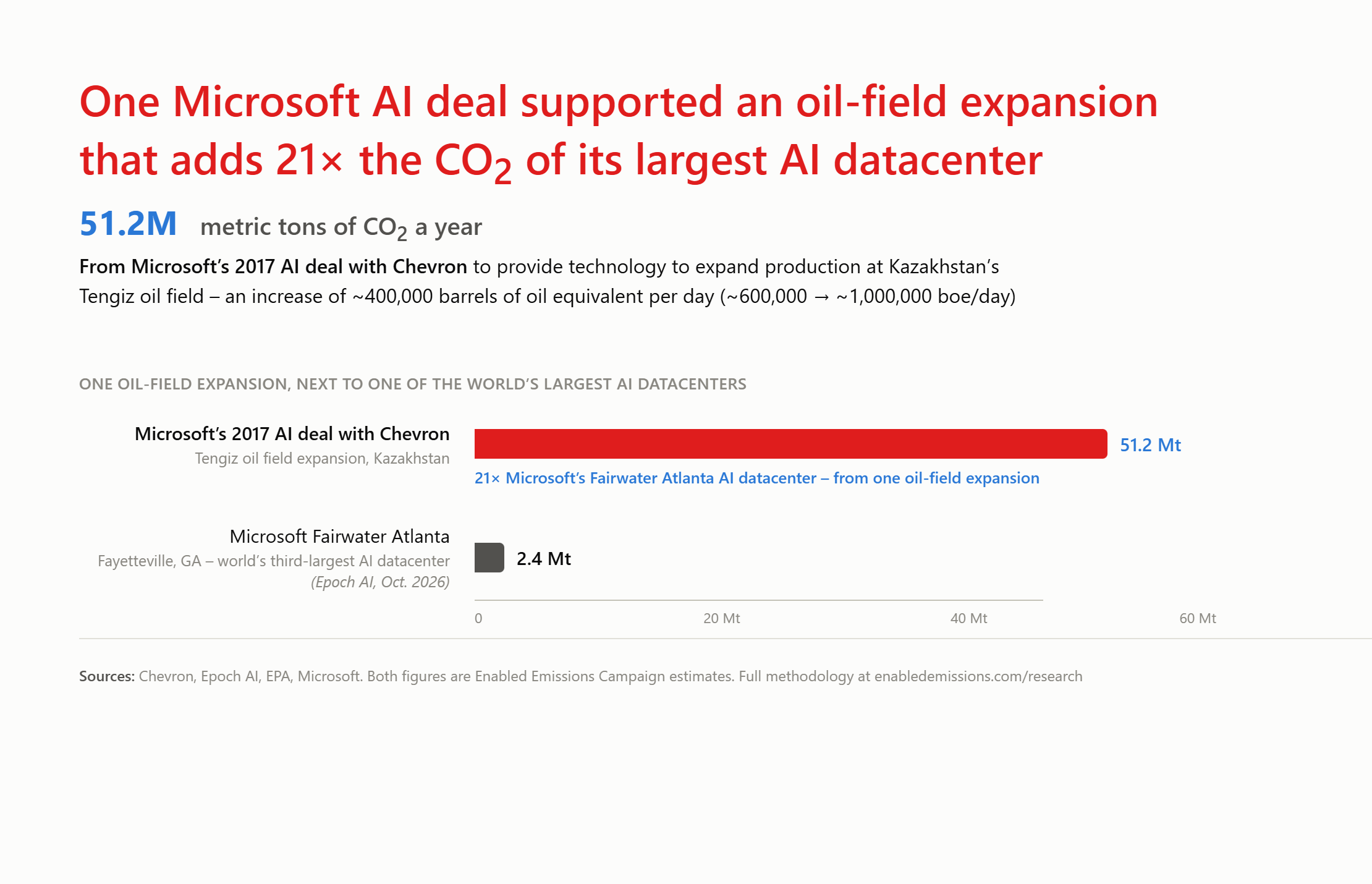
Microsoft 2017 Chevron deal vs. Largest AI datacenter
Methodology
Tengiz, 51.2 million metric tons of CO₂ a year: ~400,000 added barrels of oil equivalent a day × 365 days × 433 kg of CO₂ per barrel (EPA) × 81% combusted share. Chevron reports Tengiz’s Future Growth Project fully operational, bringing the field to nearly 1 million barrels of oil equivalent a day, up from about 600,000. Microsoft and Chevron signed their cloud and AI partnership in 2017.
Microsoft Fairwater Atlanta, 2.4 million metric tons of CO₂ a year: 636 MW of IT power (Epoch AI) × 1.12 power usage effectiveness (Microsoft’s stated design figure for its newest datacenters) × 8,760 hours × 842.3 lb of CO₂ per MWh, the regional grid average (EPA eGRID2023, SERC South). This assumes full-year operation at current capacity and uses location-based grid emissions. Microsoft reports on a market-based basis that credits its renewable energy purchases, which would give a lower figure. Epoch AI ranks Fairwater Atlanta third in the world, and first among Microsoft’s sites, by IT power capacity (October 2026).
Both are Enabled Emissions Campaign estimates, not peer-reviewed figures. For the global picture, see Alpine, Geldner, Alpine & Chepeliev, AI-driven productivity gains enable more CO₂ emissions than they avoid in a global energy–economy model, npj Climate Action (2026).
Attribution
The 51.2 million metric tons reflects the full added production at Tengiz, not Microsoft’s share of it. Microsoft’s technology was one contributor, and its exact contribution can’t be determined from public information – no accounting standard requires tech companies to measure or disclose the emissions their technology enables. For scale: if Microsoft’s technology accounted for just 5% of the added production, that alone would roughly match the annual emissions of Fairwater Atlanta.