How it Works
From reservoir to pump, AI and digital tech built into every stage of getting oil and gas to market
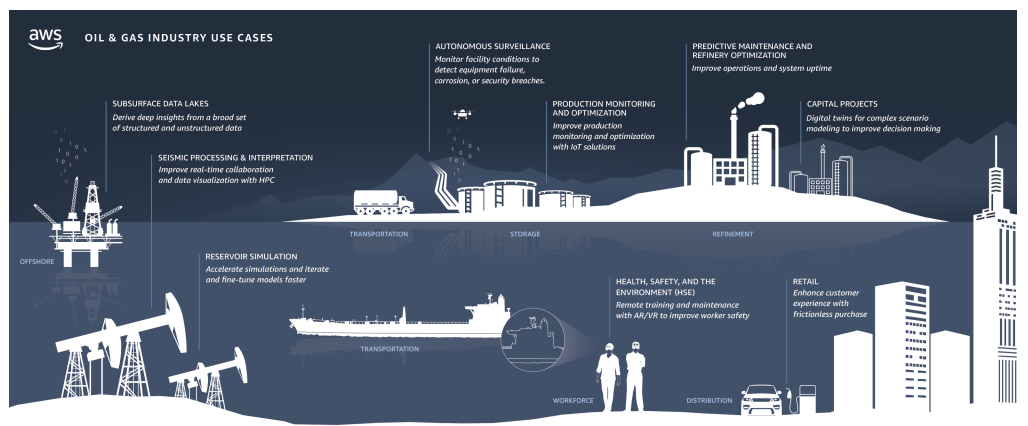
Amazon Web Services, Oil & Gas Industry Use Cases, from AWS’s oil and gas overview. AWS markets its cloud and digital services to producers at every stage, from seismic interpretation and reservoir simulation to shipping, refining, and the retail pump.
Image © Amazon Web Services, shown here for commentary. Source: AWS
Digital technology and AI are embedded at every stage of finding, drilling, producing, moving, and selling fossil fuels.
1. Finding it
Before a well is drilled, geoscientists interpret seismic surveys and decades of subsurface data to decide where oil and gas might be. AI and cloud computing let companies process that data faster and re-examine old data for resources that were missed the first time.
TotalEnergies & Mistral AI – 2026. A three-year, more than €100 million program to build AI models for exploration and reservoir engineering. TotalEnergies will pair its subsurface data and geoscience expertise with Mistral AI’s researchers to help identify reservoirs and generate multiple development scenarios for exploration opportunities. TotalEnergies
Earth AnalytiX – 2025. AI analysis of more than 5,000 wells across the UK and Norway identified hydrocarbon-bearing wells that had been written off as dry, in a project for Norway’s Petroleum Directorate. Earth AnalytiX
2. Deciding what to develop
Companies model how a reservoir will behave and decide which prospects deserve investment. Simulation and AI tools let them run more scenarios, faster, and value a prospect before they commit capital.
Wood Mackenzie – 2025. Wood Mackenzie launched AI-powered tools that identify and score comparable fields and value a prospect before it is drilled, aimed at helping producers manage portfolios and benchmark against competitors. Wood Mackenzie
Wood Mackenzie – 2025. Its analysis says AI-driven production technology could unlock roughly 1 trillion additional barrels, almost doubling the remaining recovery potential of fields already in production. Wood Mackenzie
3. Drilling it
Drilling is one of the biggest costs of getting oil and gas out of the ground. Machine learning and automation tune drilling in real time, which means faster wells, fewer equipment failures, and a lower cost per well.
ExxonMobil – 2026. Its first automated drilling rig drilled two miles horizontally in just over six days, the third-fastest time in company history, as part of a plan to grow Permian production almost 40% by 2030. Reuters, via BOE Report
ConocoPhillips. Machine learning cut drilling costs by more than $3 million in the Eagle Ford, cut drilling-motor failures by 65%, and sped up drilling by 20%. The company says it is working toward a fully closed-loop, automated drilling and completion process. ConocoPhillips
Goldman Sachs – 2024. AI could cut the cost of a new shale well by about 30%. Reuters
4. Producing it
Once wells are online, operators use sensors, digital twins, and AI to monitor output, predict equipment failures before they cause downtime, and keep production as high as possible.
Chevron & Microsoft – 2025. Chevron is spending nearly $50 billion to expand its Tengiz field in Kazakhstan to one million barrels per day, and Microsoft is working with the field’s operating team on the technology to help get there. Logic – The New York Times
Devon Energy – 2025. A 25% improvement in oil production after adopting machine learning to monitor its rigs. Reuters
BP – 2024. A digital twin built on AI software unifies real-time data from more than 2 million sensors across its North Sea, Gulf of Mexico, and Oman operations, and BP is using large language models to speed up production decisions. Offshore Technology
Shell – 2022. Monitors more than 10,000 pieces of critical equipment with AI-enabled predictive maintenance across its upstream, downstream, and integrated gas assets, using more than 3 million sensors and nearly 11,000 machine learning models to spot failures before they cause downtime. BusinessWire
APA Corporation – 2024. Palantir’s AI platform now spans APA’s production optimization, maintenance planning, and supply chain management. BusinessWire
Saudi Aramco – 2025. CEO Amin Nasser says AI and digitalization can double the productivity of a well, and the company has launched what it calls the world’s largest industrial large language model. The Arab Weekly
Equinor – 2026. Says AI contributed $130 million in value and cost savings in 2025 and is crucial to keeping production flowing from the Norwegian continental shelf through 2035. Equinor
5. Moving and storing it
Oil and gas moves by truck, pipeline, and ship and sits in storage along the way. Autonomous vehicles and monitoring systems cut hauling costs and watch facilities for equipment failure, corrosion, and security breaches.
Thunder Said Energy. Autonomous trucks could cut shale production costs by 8–10%, extending AI’s role from the geology to the trucks hauling sand and water across the oilfield. Thunder Said Energy
6. Refining it and selling it
Refineries turn crude into fuel, and stations sell it. AI predicts refinery outages so plants run more of the time and process more crude, and digital tools support worker training and the retail purchase.
Phillips 66 – 2026. Executive Vice President Tandra Perkins told a Reuters AI conference that the refiner is using AI to predict outages and cut maintenance costs. Keeping systems up more of the time lets it process more crude and capture greater margins. EnergyNow, via Reuters
Chevron and Shell – 2020. Offshore Technology reports that Chevron uses VR goggles that overlay sensor data at its El Segundo refinery to cut maintenance time and costs, and that Shell trains workers on a virtual deepwater platform to prepare them for hazards. Offshore Technology
Why this matters
No single one of these tools looks like a fossil fuel project. Together, they make it faster and cheaper to find oil and gas, drill for it, produce it, and get it to market. Each stage is a place where technology can raise output, and the emissions that follow are rarely counted as the technology’s effect.
See the full list of statements on the On the Record page.